|

Showing posts with label leslie peterson sapp. Show all posts
Showing posts with label leslie peterson sapp. Show all posts
Saturday, August 1, 2020
Story Without a Plot


Thursday, August 23, 2018
An Inspiring Trip to Greece!
My husband and I took a trip to a place I've wanted to go for a long time- Greece! We visited mainly Napflio and the Peloponnes Peninsula, the island of Hydra, up to Delphi, then Athens.
Some of you may remember that I love ancient history, and that I did a series of art based on The Odyssey. It was sensational to be in and around the place where The Iliad and The Odyssey was conceived, sung, shared, and eventually written down. In fact, we visited the ancient site of Mycenae, which was the palace complex where Agamemnon himself lived and ruled.
(If you'd like to see some of the inspiring art I saw during my trip to Greece, check out my post on my facebook page.)
Being in Greece lent depth and richness to my understanding of The Odyssey. One experience I had was the realization that my conception of the space and atmosphere was generalized and lacking in sensitivity. It was fanciful, but vague.
The sense I have now is the astounding ruggedness of the place, how rocky mountain slopes charge down and continue deep into the sea.
I also did not have a sense of the palette. These parts of Greece are dry dry dry, and the rocks are pale and crumbly. I suppose the pale rock is part of why the sea is so green-blue.
The artist whom I can think of who really got a great take on what it feels like to be a westerner, idealizing ancient Greece, is Puvis de Chavannes, a French artist active in the late 19th century.
Also, Picasso captured it, perhaps with more individuality and sophistication, in many of his early works:
Although I am committed to doing more Film Noir works for the time being, I am wondering what will transpire if I decide to do more Ancient Literature work in the future. One very inspiring object I saw during my travels is a late Hellenistic funerary urn at the Archeological Museum.
 Who knows?
Some of you may remember that I love ancient history, and that I did a series of art based on The Odyssey. It was sensational to be in and around the place where The Iliad and The Odyssey was conceived, sung, shared, and eventually written down. In fact, we visited the ancient site of Mycenae, which was the palace complex where Agamemnon himself lived and ruled.
 |
| The "Funerary Mask of Agamemnon" from Mycenae, housed at The Archeological Museum in Athens. |
Being in Greece lent depth and richness to my understanding of The Odyssey. One experience I had was the realization that my conception of the space and atmosphere was generalized and lacking in sensitivity. It was fanciful, but vague.
 |
| "The Land of the Lotus Eaters" Leslie Peterson Sapp |
 |
| Delphi, Greece |
 |
| Greece, somewhere between Epidavros and Poros |
 |
| "The Shepherd's Song" Puvis de Chavannes, 1891 |
 |
| "Patriotism" Puvis de Chavannes, 1893 |
 |
| "Young Girls by the Sea", Puvis de Chavannes, 1879 |
 |
| "Acrobat on a Ball" Picasso, 1901 |
 |
| "Two Adolescents", Picasso, 1906 |
 |
| "Boy Leading a Horse", Picasso, 1905-6 |

Monday, June 12, 2017
A Brief Primer on Collage.
Some of you have never seen my work in person. But even those of you who have, it can be difficult for people to tell how I make my art using collage. Often people don’t realize it is collage at all.
A couple of contemporary artists who do similar things are Ellen Gallager, and fellow Portland artist, Karen Wippich!
Many collage artists used found images in combination with using colored paper as a form of paint. Romare Bearden was a master of this, using photographic images to create narrative and reference, mixed with pure colored paper to support the formal aspects of the picture.
Finally, some artists use colored paper exclusively, with no found images, to build a picture from the ground up. This is the technique I use, and Romare Bearden also used this technique in his "Black Odyssey" series.
At times I will also use text, but in the manner that Schwitters did, simply as color and texture.
Finally, there is contemporary encaustic art, which often uses found imagery embedded in layers of wax, creating an atmospheric, layered affect.
There are many ways to make collage art. I would organize it into two main techniques:
1. Cutting up and combining recognizable found images
2. Using colored paper as a form of paint, building an image similar to the way a pointillist uses dots.
Many artists use some combination of the two. Each combination of techniques has its pluses and minuses, and lends itself to different intents. Borrowed imagery tends to be more conceptual, because it makes us think about the imagery in a different way. Using colored paper as paint tends to be more formal or aesthetic.
1. Cutting up and combining recognizable found images
2. Using colored paper as a form of paint, building an image similar to the way a pointillist uses dots.
Many artists use some combination of the two. Each combination of techniques has its pluses and minuses, and lends itself to different intents. Borrowed imagery tends to be more conceptual, because it makes us think about the imagery in a different way. Using colored paper as paint tends to be more formal or aesthetic.
Although the deep history of collage is ancient, the modern concept of collage probably started with Georges Braque, in 1914 (though some credit his buddy Pablo Picasso with this)
Braque first added wall paper with a wood grain print to his cubist drawings as a sort of visual pun. The collaged paper also functioned as a color to support the abstract cubist design.
He went on to use found objects and images such as text from newspapers and advertisements. Can you believe these darn things are over 100 years old?
A good example of an artist who uses found images is Hannah Hoch, who was a pioneer of the art form and used found imagery to create art that made social commentary.
 |
| Georges Braque, Still Life on a Table Gillette, 1914 |
Braque first added wall paper with a wood grain print to his cubist drawings as a sort of visual pun. The collaged paper also functioned as a color to support the abstract cubist design.
 |
| Georges Braque, Mandoline, 1914 |
He went on to use found objects and images such as text from newspapers and advertisements. Can you believe these darn things are over 100 years old?
A good example of an artist who uses found images is Hannah Hoch, who was a pioneer of the art form and used found imagery to create art that made social commentary.
 |
| Hannah Hoch, Da-Dandy, 1919 |
 |
| Hannah Hoch, Untitled, 1930 |
In the 1960's, Robert Rauschenberg combined found images with silk screen, paint and drawing.
 |
| Robert Rauschenber, Skyway, 1964 |
 |
| Robert Rauschenberg Mirthday Man, 1997 |
A couple of contemporary artists who do similar things are Ellen Gallager, and fellow Portland artist, Karen Wippich!
 |
| Ellen Gallagher, Getting Hair Did, 2005? |
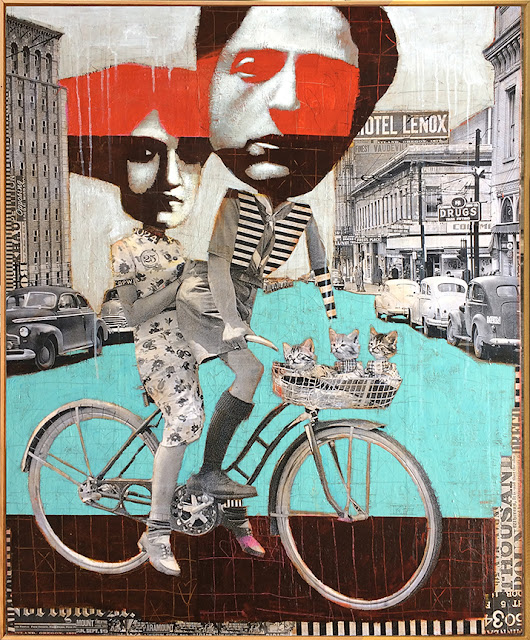 |
| Karen Wippich, Basket of Adorables, 2017 |
Kurt Schwitters is a good, early example of an artist who used paper primarily as one would use paint, to create abstract designs. Although he did use text and photographic images, they were used as color, value and texture, rather than for conceptual references. (He was also an early developer of installation art.)
 |
| Kurt Schwitters, Fur Moholy, 1934 |
 |
| Kurt Schwitters, Santa Claus, 1922 |
Many collage artists used found images in combination with using colored paper as a form of paint. Romare Bearden was a master of this, using photographic images to create narrative and reference, mixed with pure colored paper to support the formal aspects of the picture.
 |
| Romare Bearden, House in Cotton Field |
 |
| Romare Bearden, Springway, collage on paperboard 1964 |
Finally, some artists use colored paper exclusively, with no found images, to build a picture from the ground up. This is the technique I use, and Romare Bearden also used this technique in his "Black Odyssey" series.
 |
| Romare Bearden, The Water Nymph, 1970's |
 |
| Leslie Peterson Sapp, Ino and Odysseus Have a Chat, 2017 |
At times I will also use text, but in the manner that Schwitters did, simply as color and texture.
 |
| Leslie Peterson Sapp, The Paradigm, 2016 |
Finally, there is contemporary encaustic art, which often uses found imagery embedded in layers of wax, creating an atmospheric, layered affect.
 |
| Bridget Benton, Catching the Fall, 2016 |
I don't tend to use borrowed imagery because, frankly, my mind doesn't seem to work that way, and I just get all confused while I am doing it. I have chosen to do collage because cutting paper forces me to simplify shapes in a way that makes my art stronger. But who knows what direction my art will eventually go????
Thursday, May 18, 2017
Athena, Telemachus and the Origin of the Word “Mentor”
Telemachus, walking the beach now, far from others,
washed his hands in the foaming surf and prayed to Pallas:
“Dear god, hear me! Yesterday you came to my house,
you told me to ship out on the misty sea and learn
if father, gone so long, is ever coming home …
Athena came to his prayer from close at hand,
for all the world with Mentor’s build and voice,
and she urged him on with winging words: “Telemachus,
you’ll lack neither courage nor sense from this day on…”
And so Athena, daughter of Zeus, assured him.
 |
| "Telemacheia" Leslie Peterson Sapp 16"x20" Collage painting on panel. |
No lingering now—he heard the goddess’ voice—
but back he went to his house with aching heart I love the way the gods appear in mortal form throughout The Odyssey. Sometimes it is Athena, sometimes Hermes, sometimes they appear as strangers, sometimes as people known to the character in question. There is a common theme in each appearance; the character meets a person who acts as a guide or helper. After this guide or helper leaves, the character realizes they have not been talking to a mortal person, but a god in disguise. The cloaked gods are described as having a numinous quality, or being beautiful, or glittering, or youthful. In this piece I attempt to express the simultaneous presence of mortal and divine with the figure of Mentor and the face of Athena in the sea and sky.
 |
| "Telemachus knelt where the grey water broke on the sand" W. Heath Robinson |
It is not my intention to tell you the entire plot of The Odyssey here. If you want a little background you can always visit cliffnotes.com (yes, cliff notes!) to get the context of the plot. What I want to show you is why I am inspired by this scene, and also to show you other artists' versions.
At this point in the poem, Athena has decided to go to Ithaca and advise
Odysseus’ youthful son Telemachus. I am touched by Telemachus, who has grown up
without a father, and longs to find him.
 |
| "Athena and Telemachus" lithograph by Marc Chagall, 1975 |
sitting among the suitors, heart obsessed
with grief.
He could almost see his magnificent father, here …
in the mind’s
eye—if only he might drop from the clouds
and drive these suitors all in a rout
throughout the halls
and regain his pride of place and rule his own domains!
Daydreaming so as he sat among the suitors
 |
| Telemachus and King Nestor. Apulian krater. Mid-4th century BC. |
Athena persuades Telemachus, recently come of age, to go on
a journey in search of news of his father.
Telemachus is gripped with self doubt. So, he goes down to
the beach to pray. He is approached by the form of Mentor, a friend of his father.
Telemachus’ courage and conviction are revived. We all need
encouragement and guidance. Sometimes we turn to those in our lives, and
sometimes we turn to a spiritual practice. And sometimes it feels as though the
divine universe has sent us someone to help us on our way… like a mentor.
Friday, April 14, 2017
Penelope, the Matchless Queen of Cunning
So by day she’d weave at her
great and growing web—
by night, by the light of
torches set beside her,
she would unravel all she’d
done.
 |
| "Penelope, the Matchless Queen of Cunning" Leslie Peterson Sapp 16"x20" Collage, acrylic, cheese cloth, fiber paste |
Aside from the interesting literal story, this scene also taps into the archetype of Woman as Weaver, or the Weaver of Fate or Destiny. This is a universal archetype, with versions in cultures all over the world and across time.
 |
| Mayan Teotihuacan Spider Woman |
Included in my depiction is a
couple fanciful elements: The tiny ship in the deep background… could it be
Odysseus coming home? Also, the scene she is weaving is about Scylla and Charybdis,
an incident in Odysseus’ adventures that Penelope could not possibly have known
about. I thought it would be interesting to propose that maybe she is
unconsciously following her husband’s wanderings in her dreams or in her deep
creativity.
 |
| "Penelope Unravelling Her Work at Night" Dora Wheeler, 1886 Silk embroidered with silk thread |
I also like this scene because Penelope is a person who is making the best of a situation where she is almost powerless, and must use her cleverness and guile to survive. She is put
into a difficult position by her husband’s extended absence, a position that is
difficult for us to comprehend today. It displays a big difference not only in
the position of women in society and succession of kingship and property, but
also of the sacred tradition of hospitality.
To learn a bit about hospitality,
read the analysis section of cliffnotes.com or a great article about The Odyssey in one of my favorite online magazines, The Art of Manliness.
 |
| Penelope and Laertes’ Shroud. Red Figure Red Vase. S. 440 BC. |
For a description of the context of this scene, look at cliffnotes.com.
Monday, March 20, 2017
The Land of the Lotus Eaters
So off they went and soon enough
they mingled among the natives, Lotus-eaters, Lotus-eaters
who had no notion of killing my companions, not at all,
they simply gave them the lotus to taste instead …
Any crewmen who ate the lotus, the honey-sweet fruit,
lost all desire to send a message back, much less return,
their only wish to linger there with the Lotus-eaters,
grazing on lotus, all memory of the journey home
dissolved forever.
The Lotus Eaters is another brief but well known episode in The Odyssey, and takes place on one of the
many islands that Odysseus and his crew stop at, and they barely escape. Not
because of a fighting foe, but because a potential pitfall of basic human
nature.
they mingled among the natives, Lotus-eaters, Lotus-eaters
who had no notion of killing my companions, not at all,
they simply gave them the lotus to taste instead …
Any crewmen who ate the lotus, the honey-sweet fruit,
lost all desire to send a message back, much less return,
their only wish to linger there with the Lotus-eaters,
grazing on lotus, all memory of the journey home
dissolved forever.
 |
| "The Land of the Lotus Eaters" Leslie Peterson Sapp 16"x20" Collage painting on panel |
Most of the time people interpret this scene with two
meanings; either The Lotus Eaters people who are lost in drug addiction, or people
who have rejected society’s requirement to work, or strive, to achieve, and
they live in the moment, at peace and one with nature. There is a famous Tennyson poem about it. Here is a link to an essay by Mike Jay about how the The Lotus Eaters symbolizes a rejection of over work, progress, colonization, imperialism.
I have a pretty unconventional version of the Lotus Eaters in this series, in fact, you could say I took a flight of fancy to a meaning no one else, as far as I know has arrive at.
When I start working with an image, I often start with a google search of images, to see who else out there has painted the scene and how they interpreted it, how they dealt with the space, the positioning of the characters, etc. When I did a search for the Lotus Eaters I ran across some pretty unexpected images.
Some were connected to The Lotus Eaters, a new wave band from the early 80’s. They were one of the very earliest bands that were ascribed a gay identity.

 Along the same lines I came across the a Yaoi graphic novel series called The Lotus Eaters. Yaoi is a genre of graphic novels and fiction from Japan that focuses on same-sex romances between boys (but produced for a female audience).
 From these things I made a leap from The Lotus Eaters being a symbol not only of the rejection of work and strife to being a rejection of the masculine compulsion to prove one’s masculinity. What if the incident is a fable for men’s’ constant anxiety to appear strong, capable, macho, and above all, not gay? What if the horror of being perceived as gay is enough to compel one another to never even touch on that isle for fear that once you taste it, you’ll never escape?
But I brought them back, back
to the hollow ships, and streaming tears—I forced them,
hauled them under the rowing benches, lashed them fast
and shouted out commands to my other, steady comrades:
'Quick, no time to lose, embark in the racing ships!’—
so none could eat the lotus, forget the voyage home.
They swung aboard at once, they sat to the oars in ranks
and in rhythm churned the water white with stroke on stroke.”
 |
| "The Lotus Eaters" W. Heath Robinson |
When I start working with an image, I often start with a google search of images, to see who else out there has painted the scene and how they interpreted it, how they dealt with the space, the positioning of the characters, etc. When I did a search for the Lotus Eaters I ran across some pretty unexpected images.
Some were connected to The Lotus Eaters, a new wave band from the early 80’s. They were one of the very earliest bands that were ascribed a gay identity.


But I brought them back, back
to the hollow ships, and streaming tears—I forced them,
hauled them under the rowing benches, lashed them fast
and shouted out commands to my other, steady comrades:
'Quick, no time to lose, embark in the racing ships!’—
so none could eat the lotus, forget the voyage home.
They swung aboard at once, they sat to the oars in ranks
and in rhythm churned the water white with stroke on stroke.”

I think Odysseus’ reaction is hilarious; “Quick! No time to
lose! Let’s get the heck outta here before anyone else eats these flowers!” He
knew that if too many of his men tasted the flower, his plans to return to
Ithaca would be doomed.

Subscribe to:
Posts (Atom)